When we think of the Scandinavian countries, their contribution to Modern architecture and design is one of the strongest elements of their collective global image with the works of Alvar Aalto, Jorn Utzon and Arne Jacobsen amongst many others, admired around the globe. From the 1930’s onward, Modernism was more quickly and widely accepted in the region than in any other part of the world and soon became inextricably linked with their post-war social democratic vision of the welfare state. It is all the more surprising therefore that they were actually relatively late adopters and almost entirely uninvolved with the early development of Modernism.
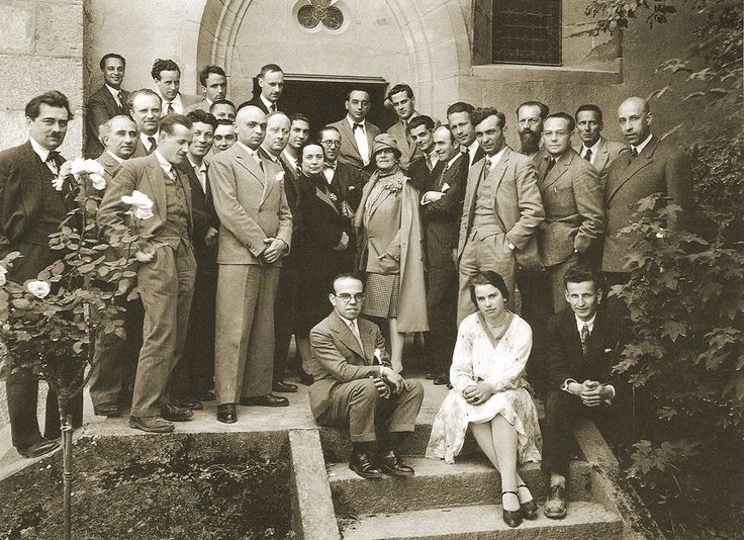
The group photograph above shows the first meeting of the Congrès Internationaux d’Architecture Moderne in Switzerland in June 1928. By the time of this meeting, the Weissenhof Housing Exhibition in Stuttgart, Gropius’s Bauhaus buildings in Desau and Le Corbusier’s Paris Villas La Roche and Stein were already completed. The group included Walter Gropius from Germany, Gerrit Rietveld from the Netherlands, Andre Lurcat from France and in the centre with his trademark glasses, Le Corbusier himself. The notable exceptions were any representatives from the Scandinavian countries. While all this was going on in Central Europe, Scandinavian architecture was undergoing another Classical revival led by Gunnar Asplund.
The catalyst for change was Swedish architect Sven Markelius who visited Germany in the summer of 1927, met Gropius and invited him to lecture in Stockholm in March 1928. It was around then that Alvar Aalto moved his office from Jyvaskyla to Turku, both to better supervise the projects that he had won there and just as importantly, to be just a ferry ride away from Stockholm and the leader of the new Functionalism in Scandinavia – Markelius. In October 1929 Markelius was invited to join the CIAM meeting in Frankfurt and was given permission to bring both Aalto and the Danish lighting designer Poul Henningsen with him to meet the heroes of the Heroic period of the Modern Movement.

Despite Markelius’s and increasingly Aalto’s efforts to promote Modernism in their region, it was the conversion of the leader of the Nordic Classical movement Gunnar Asplund to Modernism, which proved to be the tipping point. Asplund’s brilliant Stockholm Exhibition of 1930 (above) offered Scandinavians a vision of the cleaner, fairer, healthier, egalitarian utopia which they now aspired to and from that starting point Scandinavian Modernism developed, flourished and for the first time in the history of the region, contributed hugely to the development of world architecture and design.
If you don’t want to miss out on further blogs then follow me on johngooldstewart.com
 John Stewart