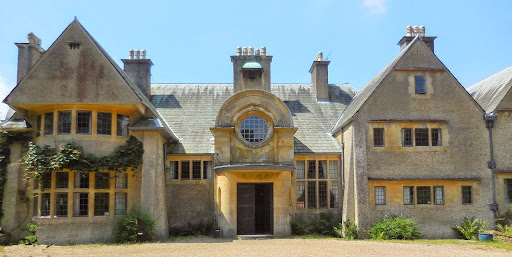
If you’ve been envying Carey Mulligan her restrained and yet also rather sumptuous house on ‘The Dig’ then you might like to know that it’s actually ‘Norney Grange’ in Surrey of 1897 by the English Arts and Crafts architect, Charles Francis Annesley Voysey (1857-1941). Despite its rather unusual entrance with the arched circular window which lights the double-height entrance hall behind and bowed entrance doorway, it is nevertheless a typical example of Voysey’s mature style, in which he combined white roughcast buttressed walls with warm golden sandstone mullions and doorcases, below cold blue slate roofs.
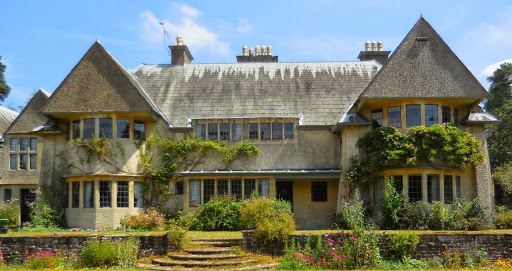
Although derived from the old English vernacular, his houses didn’t vary in response to local materials or traditions and they are all pretty much the same whether they are in leafy Surrey or rugged Westmoreland – having achieved “a particular kind of perfection”, he simply executed variations on this theme, as his clients expected. Despite being one of the most talented architects of his generation, in his own words, he “made no claim to anything new” and largely anticipating the architecture which succeeded the First World War, he increasingly despaired that “Materialism has given rise to a thirst for artificial excitement”.
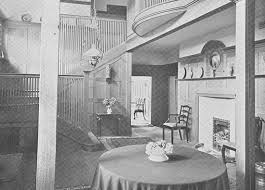
This isn’t the first time that Norney Grange has been used as a film location and indeed both his sublime ‘Broadleys’ on Lake Windemere (below) and ‘New Place’ in Surrey appeared along with Meryl Streep and Jeremy Irons in the film of John Fowles ‘French Lieutenant’s Woman’ some years ago. This popularity is hardly surprising as they are exceptionally beautiful houses whose interiors speak of a pre-industrial rural simplicity and connection with nature that simply grows more and more attractive every year. What is truly remarkable is that these houses are equally admired by architects and non-architects, and not many new buildings these days achieve that, or even aspire to.

If you don’t want to miss out on further blogs then follow me on johngooldstewart.com
 John Stewart