The Albert Memorial

The sad news of the death of the Duke of Edinburgh signals the approach of the end of an era. Despite being the longest-serving royal consort in British history, it seems unlikely that he will be commemorated in the same way as the last Prince Consort – Albert – the husband of Queen Victoria, who died at the more tender age of 42, in 1861. His memorial, erected by his grief-stricken Queen (and funded entirely by public subscription), has never been surpassed in Britain in terms of its sheer size, scale, elaboration or complexity.
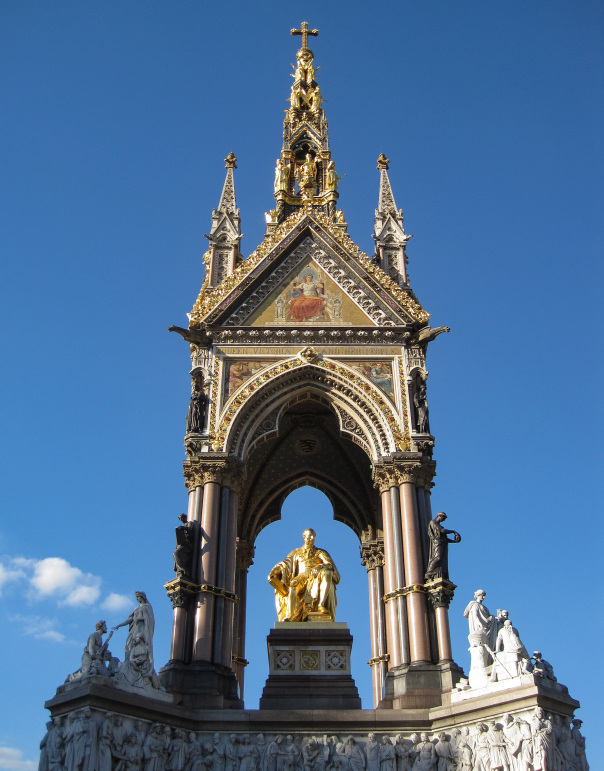
Sir Giles Gilbert Scott’s great Gothic baldacchino was selected from the many designs submitted by the Queen herself, with construction starting two years after Albert’s death in 1862 and ongoing until Victoria formally unveiled the central statue of Albert in July 1872. His gilt bronze statue, which portrays him holding the catalogue of The Great Exhibition of 1852 whose organisation he led, is however just one of the many hundreds of sculpted figures which adorn the structure and celebrate his wife’s empire and his own life and achievements.
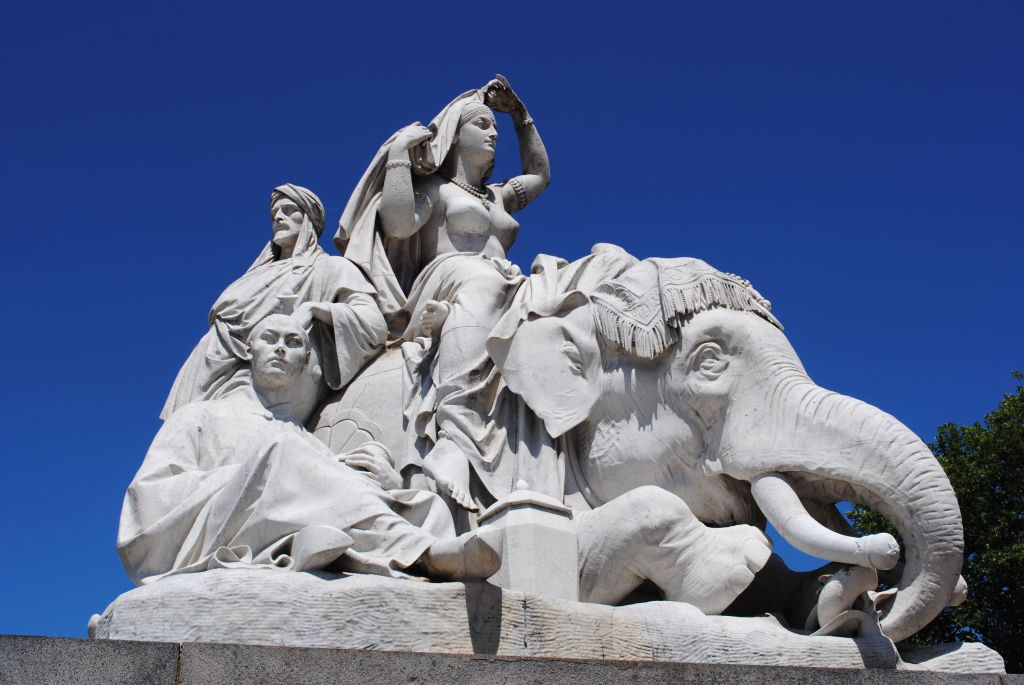
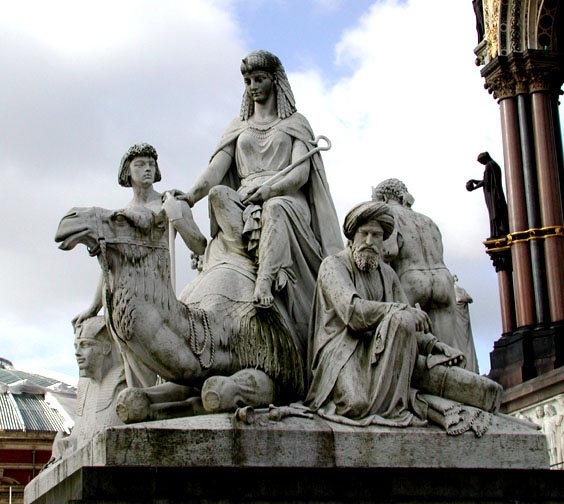
The four outermost corners of the monument have sculpted groups portraying the continents of America, Africa, Asia and Europe – each by one of the leading sculptors of the period, with Asia including a rather racy topless India astride an elephant, supported by equally exotic representatives of China and the Middle East, by sculptor John Henry Foley. The monument itself is supported by four inner groups representing Commerce, Engineering, Manufacturers and Agriculture, while on the main piers are sculptures of the physical and natural sciences, with the main canopy above, decorated with representations of the Virtues.

Every inch of the stone structure is carved – mostly by the London firm of architectural sculptors Farmer and Brindley, with whom architect Gilbert Scott worked on most of his building projects and Scott too had a key role in the selection of all the sculptors, including the rejection of Baron Marochetti’s proposed ‘Albert’ in favour of a further sculpture by Foley.
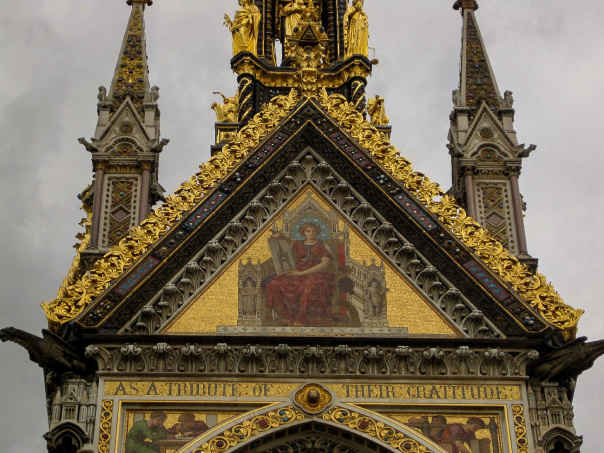
This extraordinary memorial stands today, not only as a commemoration of Queen Victoria’s Prince Consort, but also as an extraordinary work of art, a symbol of her reign – a sculptural Encyclopaedia Britannica – evoking the values and aspirations of a very different Britain. Let us hope that, at a time when most debate around statues is about their removal, Prince Philip’s contribution to British life is commemorated in perhaps a little more modest affair.
If you don’t want to miss out on further blogs then please follow me on johngooldstewart.com
 John Stewart