
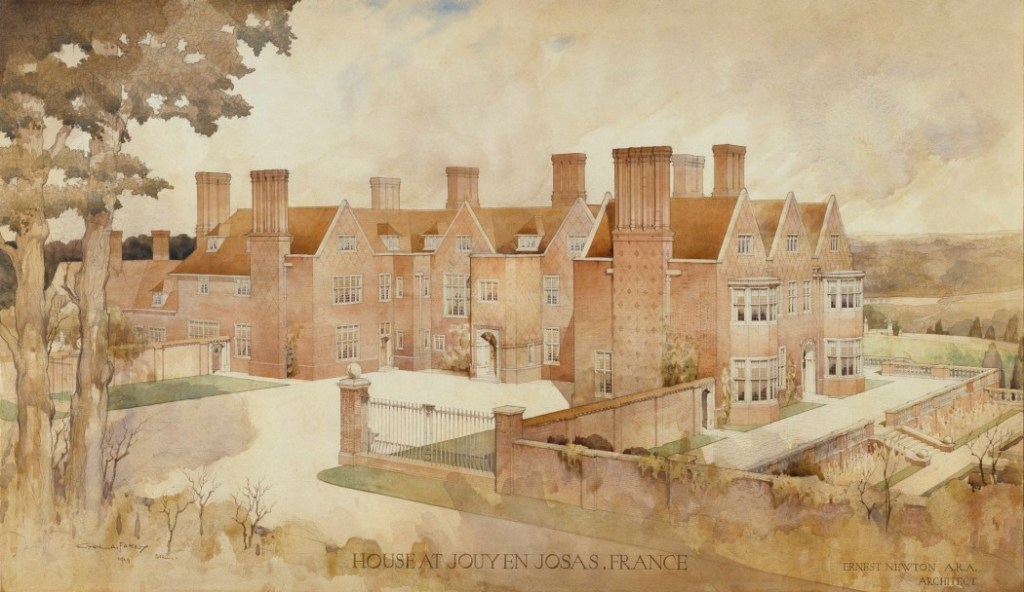
The extraordinarily realistic effects of current 3D rendering are quite astonishing but it remains a technical process, rather than an art. Before CAD, the only route to a three-dimensional representation of a proposed building was to set up two vanishing points and laboriously create a perspective drawing and in the early twentieth century, the production of illustrative perspective renderings became something of an art form in itself. Almost all the most sought-after illustrators were architects themselves and while they usually ran their own practices, it was as ‘architectural draughtsmen’ that they found fame. Two men dominated this art in the 20’s and 30’s – the brilliant Cyril Farey and William Walcot.
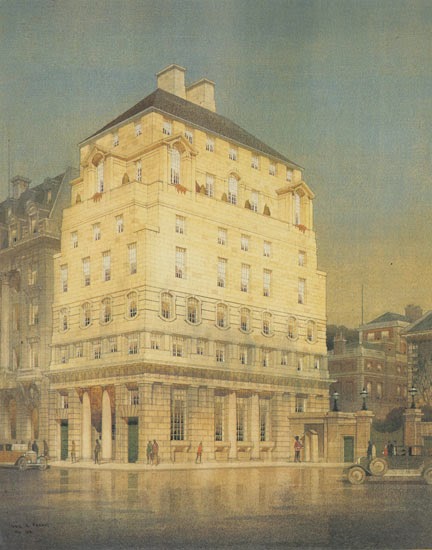
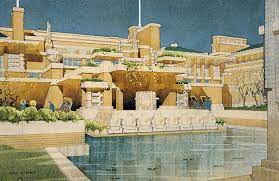
Farey (1888-1954) – Edwin Lutyens favoured perspective artist – was a prize-winning architectural student who ran a successful London practice specialising in small churches and private houses, but it was his draughtsmanship that made him one of the wealthiest members of his profession (reputedly earning over £5000 a year in the 1920’s). As well as perspectives of Midland Bank (Poultry), Castle Drogo, Marlborough Court and Liverpool Cathedral for Lutyens, he was even commissioned by the great Frank Lloyd Wright to produce a drawing of his proposed Imperial Hotel in Tokyo. His work was intensely atmospheric, whether portraying the bustle of London, the tempestuousness of Dartmoor or the tranquillity of Flanders Fields. Sadly, there was little demand for his soft washes, brooding shadows and subtle line weights after World War II.
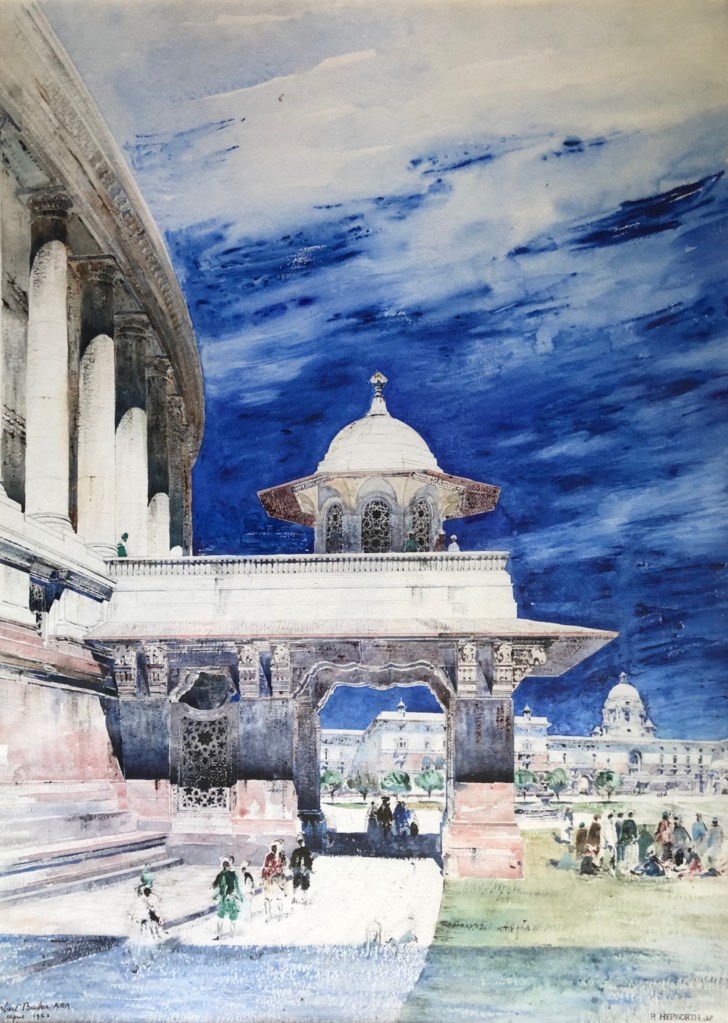
William Walcott (1874-1943) was born in Odessa to a mixed Scottish-Russian family and he studied in St Petersburg and Paris before establishing a successful architectural practice in Moscow, completing several major buildings, including the surviving Metropol Hotel. He moved to London in 1906 after which he established himself not only as a very successful architectural draughtsman but also as the leading etcher of his day. He developed a strongly impressionistic style in gouache and watercolour, becoming a regular illustrator of fellow architects’ designs at the Royal Academy Summer Exhibition. Of all his many superb illustrations perhaps the most famous were his set of perspectives of Imperial Delhi which he produced for Edwin Lutyens and Herbert Baker which were said to have ‘radiated the heat of India’. Lutyens later claimed that they had ‘misled’ him, but as the architect of most of the buildings, it was a pretty lame excuse for his own mistake. Unfortunately, WW2 brought his practice to a crashing halt and he committed suicide in 1943.
More successful as an architect and slightly less so as an architectural draughtsman was Philip Dalton Hepworth (1888-1963) who was a good friend of Cyril Farey. Hepworth studied at the AA and the École des Beaux-Arts, before establishing a successful practice after serving in the First World War, culminating in the suave stripped-down classicism of Walthamstow Town Hall. Described as “an architect of great speed and brilliance,” his free style as a perspective artist was also much sought after by his contemporaries to illustrate their schemes. Fortunately, he survived the Second World War and was appointed as a principal architect by the Commonwealth War Graves Commission designing a number of cemeteries and memorials throughout Europe until his death in 1963.
If you don’t want to miss out on further blogs then please follow me on johngooldstewart.com
 John Stewart