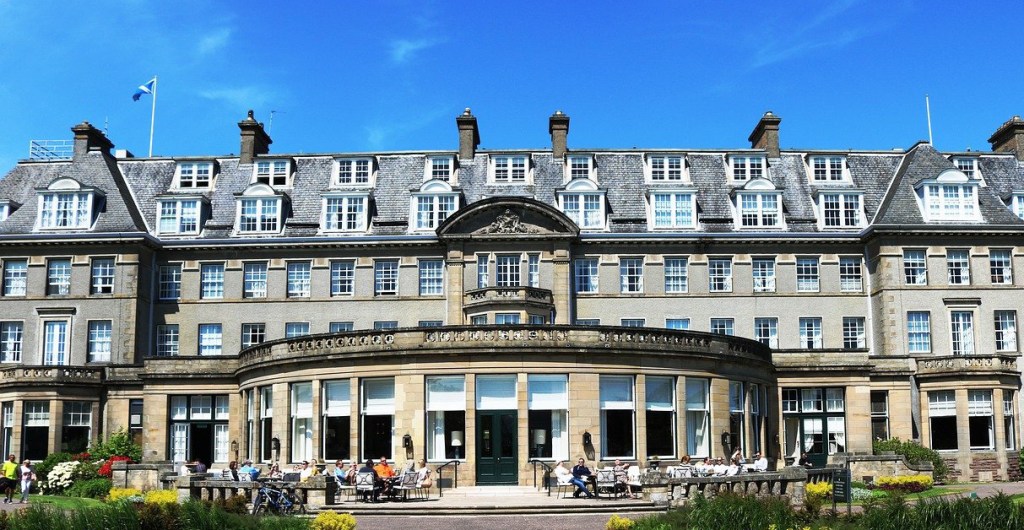
Gleneagles Hotel is just one of the many outstanding buildings designed by Scotland’s most prolific architect, James Miller (1860-1947). It was the third of his great Scottish resort hotels, all of which were built by railway companies to encourage recreational travel, following his completion of Turnberry Hotel in 1905 and Peebles Hydro Hotel in 1907. His client for Gleneagles was Donald Mathieson, the general manager of the Caledonian Railway Company – the two men had been school friends at Perth Academy and had already worked together on the design and construction of numerous new railway stations throughout Scotland as well as the rebuilding of Glasgow’s massive Central Station.
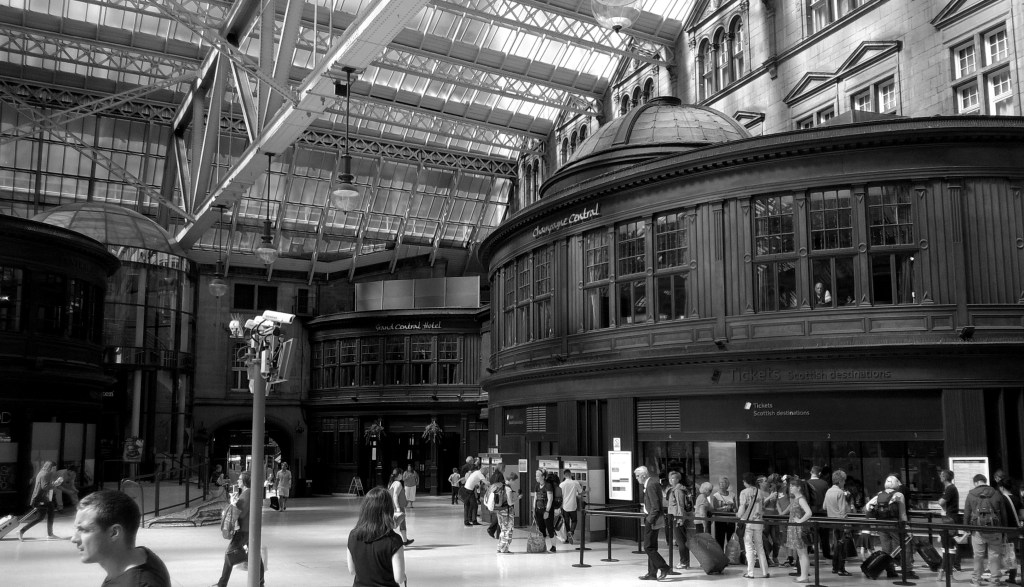
Both Mathieson and Miller now lived and worked in Glasgow but Mathieson often returned to his native Perthshire for family holidays and had found a particular spot near Crieff Junction Railway Station that he thought would be perfect for another destination hotel and he took the name of a nearby pass through the Ochill Hills – ‘Glen Eagles’ – as the name for a new station and the nearby resort that he planned. Miller’s appointment was assured and his team were soon hard at work on their largest hotel commission to date, with Open Champion and leading golf course designer James Braid appointed to lay out two new eighteen-hole courses around the hotel.

Miller’s site for Gleneagles Hotel was unlike both Turnberry and Peebles Hydro – both of these occupying elevated positions on a ridge. At Gleneagles, the hotel was to be below the hills and the golf courses and surrounded on all sides by breath-taking scenery and his response was thus a more compact building – a U-shaped block which was centred on a generous semi-circular south-facing dining room bay from which the buildings stepped back and out towards the back, thus maximising the number of rooms with a view. As at Turnberry and Peebles previously, it was to be in white-washed roughcast with sandstone dressings below a slate roof. The main public spaces including the dining rooms, bars and ballroom were all designed in a relatively restrained Edwardian Baroque, with construction commencing in 1913.
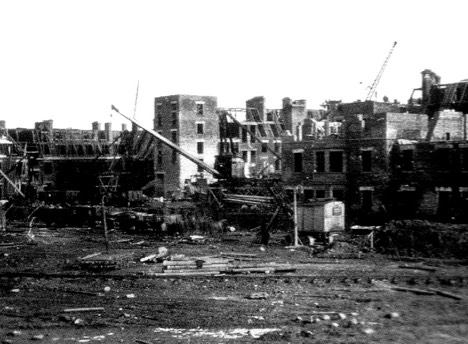
Just a year later, the outbreak of the First World War stopped work completely with little more than the foundations and the walls built, and so it remained for many years, with no guarantee of eventual completion. It was not until 1922 that Donald Mathieson finally decided to continue with the construction of the building and sadly for his good friend Miller, Mathieson had so little work then for his own engineering team, that he instructed them to oversee completion without Miller’s further involvement. While the interiors were faithfully completed to Miller’s designs, the exterior was left unpainted in the grey harling in which it stands today. Unlike many of these vast remote resort hotels (such as Cruden Bay in the north of Scotland, where only the golf course remains), Gleneagles was an immediate success when it finally opened in 1924, and it still remains one of the world’s great luxury hotels.

You can read more about James Miller in my joint biography of him and J.J. Burnet ‘The Life and Works of Glasgow Architects James Miller and John James Burnet’ which was published in November 2021 and if you don’t want to miss out on further blogs then please follow me on johngooldstewart.com
 John Stewart