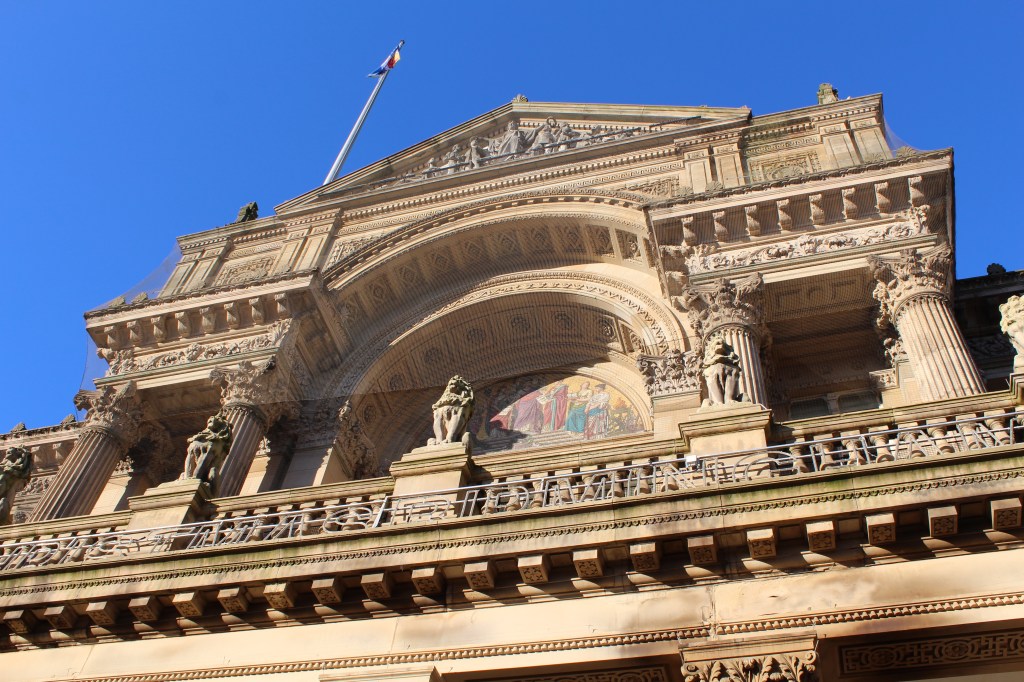
The late nineteenth century was a great period of town hall building around the western world. In Britain, society was undergoing immense change and it was the increasingly wealthy middle class who were now in the ascendancy. As a result of the Great Reform Act of 1832 and further extensions of the franchise in 1867, it was they who were now also regularly becoming the clients of architects and sculptors engaged on the design of town halls, schools, universities, professional institutions, museums and art galleries and for the first time, they also began to commemorate themselves in public statuary. In 1871, the aldermen of what was then Birmingham Town Council held an architectural competition for the design of their new town hall (the Council House), eventually selecting local architects Yeoville Thomason’s Classical proposal with the firm of Richard Lockwood Boulton and Sons, who had a yard in Birmingham, also selected to undertake the architectural sculpture.
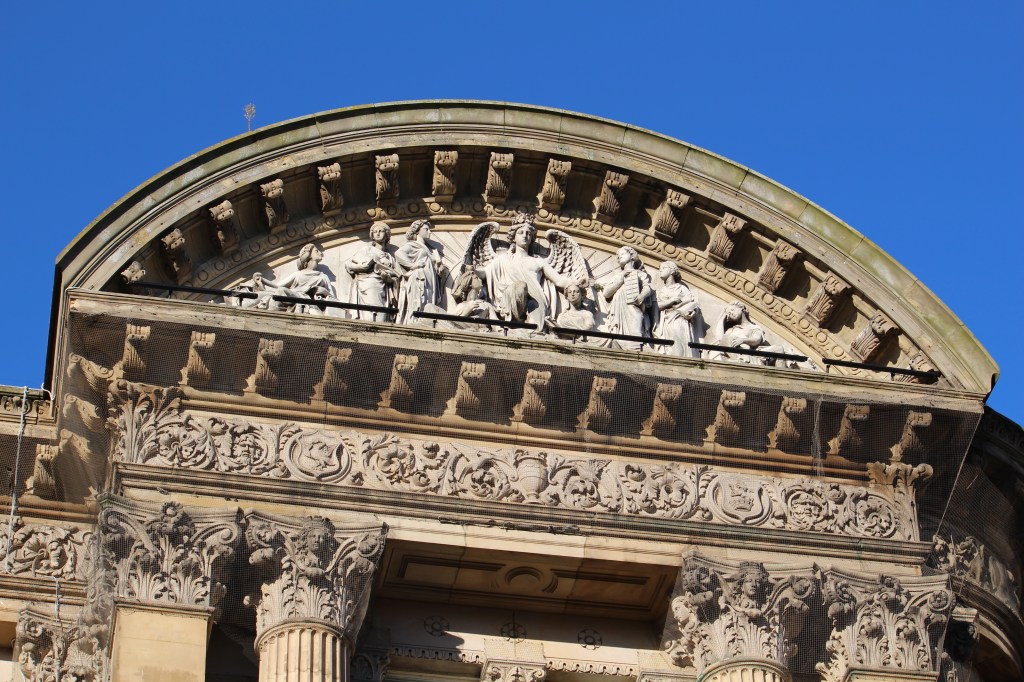
It was decided that the arch over the main entrance should have a mosaic in lieu of sculpture (which was executed by Salviati Burke and Company of Venice), but the five pediments which top the wings and central advanced section of the building were all graced with allegorical sculpture by Boulton and Sons. The four outlying pediments are curved and within their deeply coffered arches are groups representing Manufacture, the Union of the Arts and Sciences, Literature and Commerce – thus echoing the themes of the Salviati mosaic (along with almost every other Victorian bank and town hall).
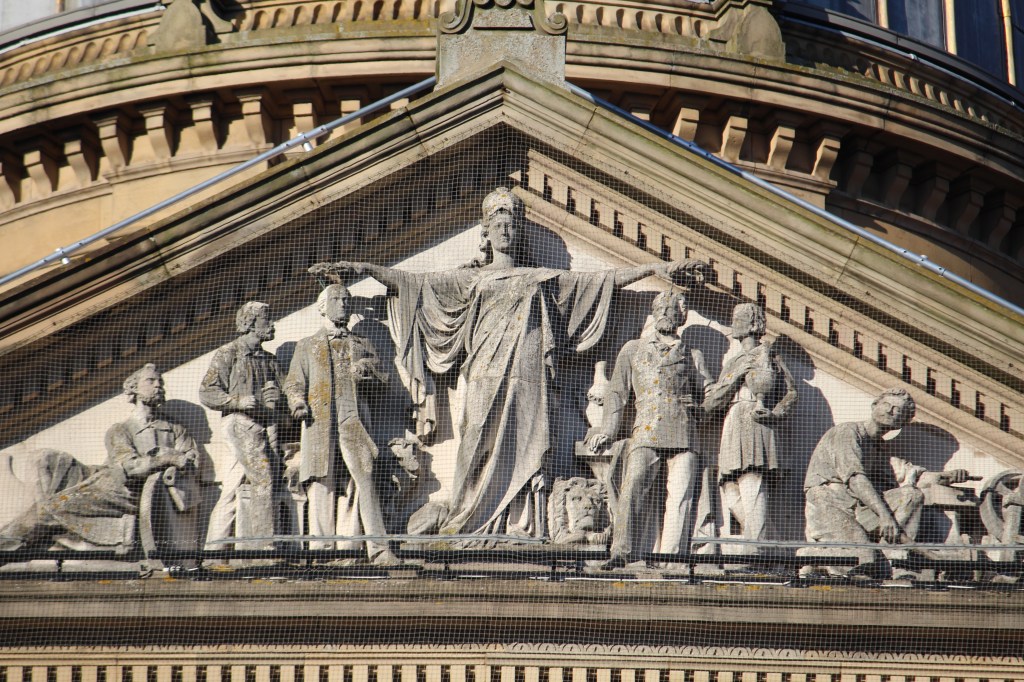
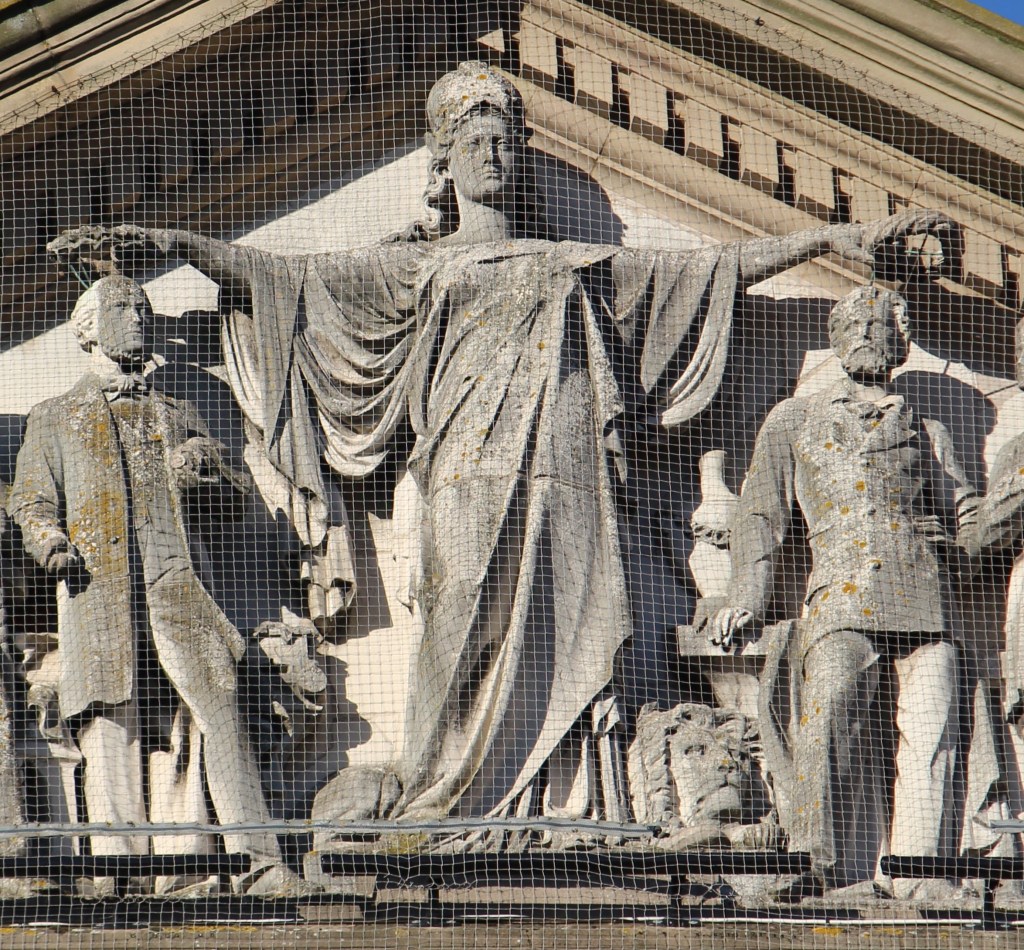
The central triangular pediment however offers a much more radical vision of late Victorian society, with Britannia in classical garb with her arms outstretched, here representing the nation (a very clear rejection of Queen Victoria, who by then was almost always centre-stage), flanked, not by further allegorical sculptures of Truth, Wisdom or Learning as one might expect, but instead by two suited industrialists with outside them, standing back and crouching within the angled corners, four bare-armed and aproned members of the working class, surrounded by the flotsam and jetsam of the town’s manufacturing trades, and just in case anyone missed the central meaning of all this, Britannia is holding two laurel leaf crowns above the industrialists’ heads. Times were changing and even then, a less deferential society was emerging, with the successful industrialists of Birmingham seeing themselves as the ones responsible for the creation of Britannia’s wealth and new position as global top-dog as opposed to the upper classes, who had inherited their wealth and social position.
My latest book on ‘British Architectural Sculpture from the Great Exhibition to the Festival of Britain’ will be published by Lund Humphries in 2023.
If you don’t want to miss out on future blogs please follow me on johngooldstewart.com.
 John Stewart