Blog 4
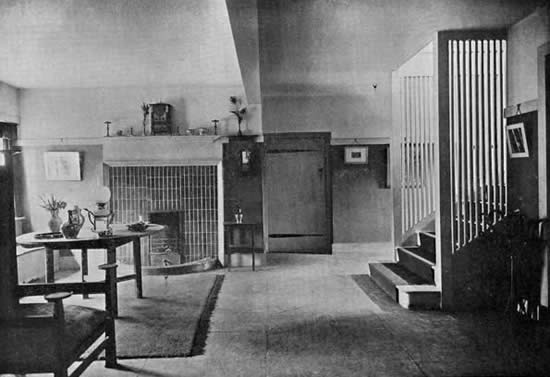
Isn’t it strange how followers of the cult of Modernism evaluate all late 19th and early 20th century architects almost entirely in terms of their contribution to the emergence of Modernism. Even more ridiculously, they project Modernist ideals onto architects who had no interest whatsoever in the principle tenets of the Modern Movement. I recently read that “Voysey (the Arts and Crafts architect Charles Frances Ainsley Voysey 1857-1941) didn’t like being referred to as a Modernist.” This might be because, despite the simplicity of his interiors and restrained palette of his exteriors, he had no interest in Modernism. Far from celebrating industrialisation and its products and considering the house to be “a machine for living”, like all the other members of the Arts and Crafts Movement, he yearned for a simpler, pre-industrial age. Far from reducing the enclosure of space to a few intersecting planes, he designed rooms of elegance and simplicity (such as in his own house The Orchard, 1899, above) and rather than considering “Ornament as Crime”, he designed wallpaper, fabrics and exquisite silverware. His fascination was not with the future but with the past and his aim was to connect with it, rather than reject it. He was not a Modernist but simply one of the finest of Britain’s many outstanding Arts and Crafts architects.
 John Stewart