I was very fortunate to have the opportunity to spend quite a bit of time in Ahmedabad in Gujarat in India some years ago. After ticking off Le Corbusier’s Millowners Association Building, Louis Kahn’s Institute of Management and Balakrishna Doshi’s Sangath Workspace, I moved off into the foreign territory of traditional Indian architecture. Amongst the intricately carved temples and tombs, there was one particular type of structure that I found absolutely fascinating and which was particularly well represented in Gujarat – the extraordinary and entirely unique, Stepwells of India.
These beautifully decorated subterranean spaces provided a number of both secular and sacred functions, principal among which was the harvesting of water in the near-desert climate of Gujarat. Here, the water table could be as much as 60 metres underground and the wells provided reliable year-round access to a water supply. Additionally, the wells were filled during the brief monsoon season every year, with their continuous flights of steps providing access to the water at whatever level it stood, as it then receded. The water was used for drinking, irrigation and religious ablutions and, as the collection of water was ‘women’s work’, the wells also became cool, social spaces for the women of their towns or villages during the hottest part of the day. As places of religious devotion, they were often linked to temples and the deities to which they are dedicated are celebrated in their intricately carved surfaces. The other important function of the continuous steps was to act as a buttress to the tons of earth that they held back, and where the well is of a straight shaft type, each level of the construction acts as both a social space and a further bracing structure.
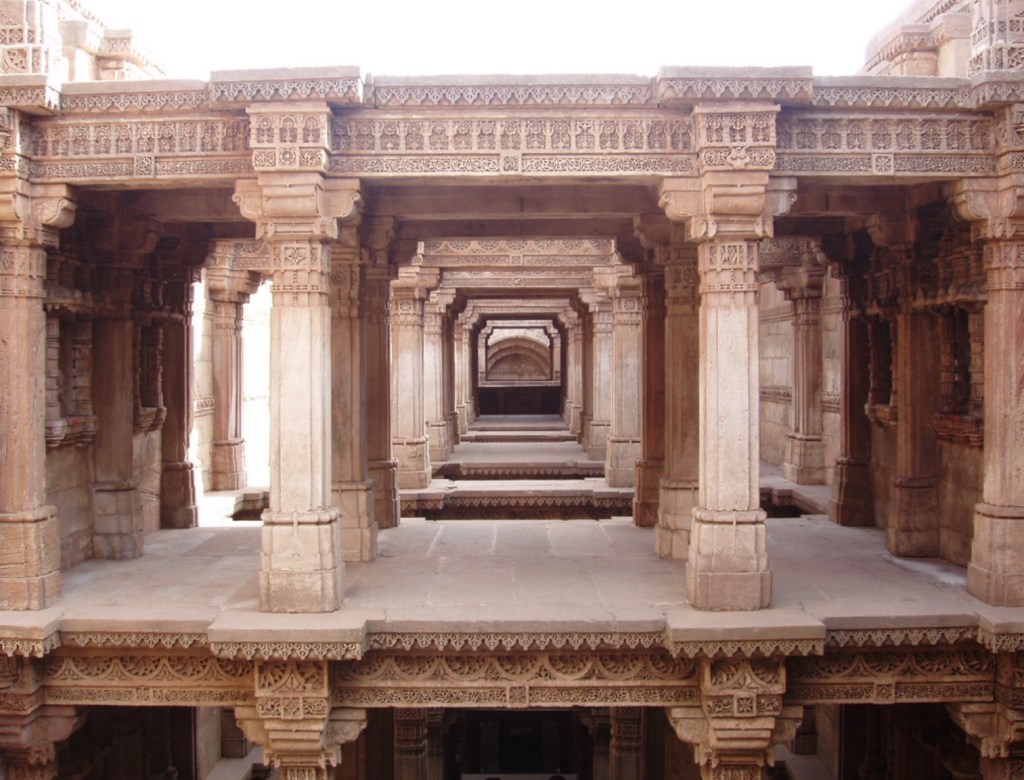
The first one that I visited was one of the most famous at Adalaj (above) just a few miles outside Ahmedabad. I was dropped on the edge of the village with my driver pointing to an area of flat paving which he assured me was the well. It was only as I was almost on top of it that the ground just opened up below me to reveal five stories of subterranean structure, concluding in an octagonal pool and vertical shaft. As I descended through level after level, it was one of the greatest architectural experiences of my life, with each level provided with cool stone benches from which to appreciate the architecture and the detail of the stunning stone carving.
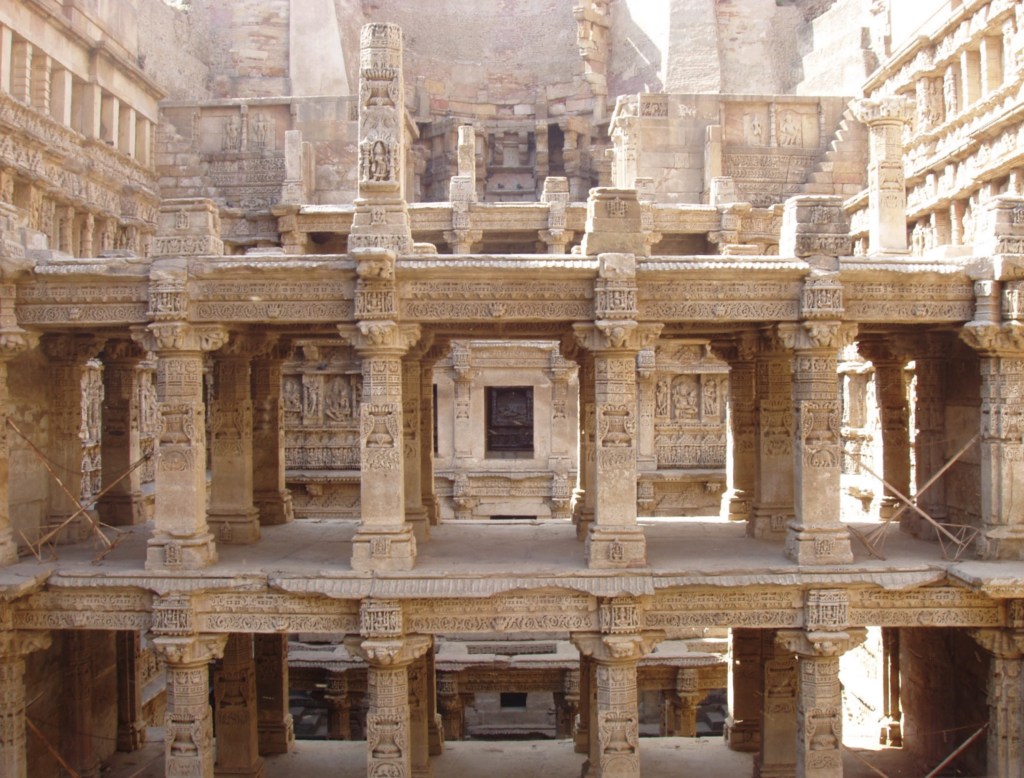
Next came Patan – one of the oldest wells in India (above) which was started in 1063 and constructed of stone which was brought from a quarry nearly 90 miles away. As happened with a number of the stepped wells, it had dried up after a few hundred years and was abandoned, eventually almost completely silting up until its excavation in the 1980’s when its beautifully-preserved carvings were revealed for the first time in centuries. Unlike popular Adalaj and despite its UNESCO World Heritage status, I had the well entirely to myself for several hours.
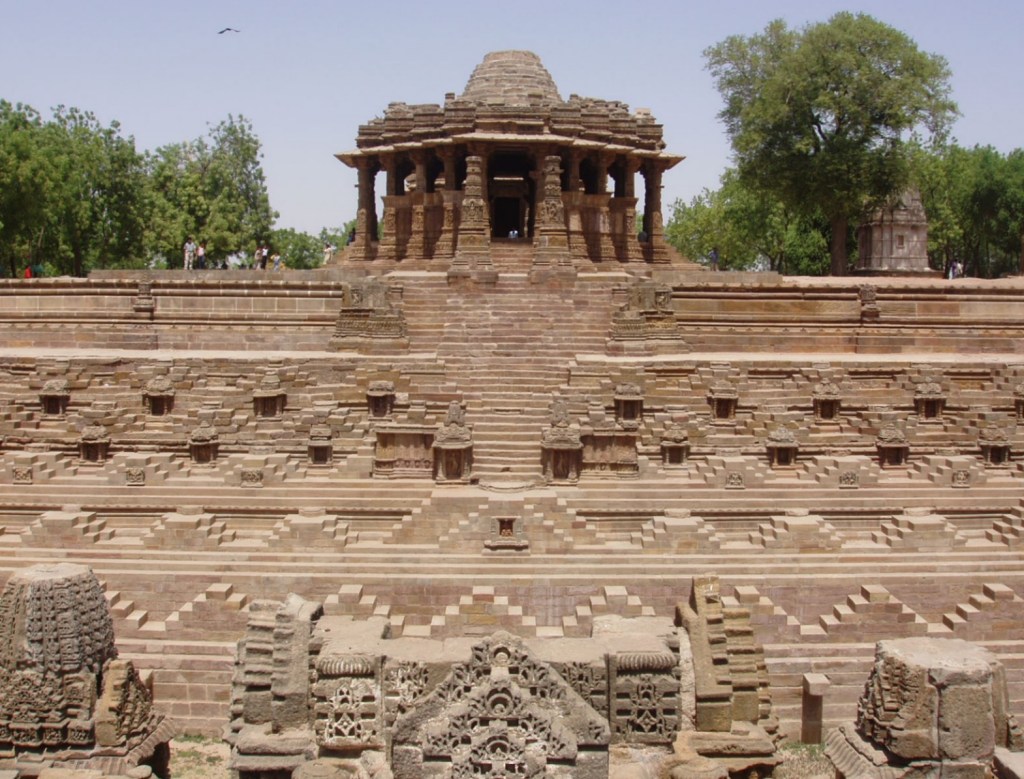
The most spectacular of them all is surely the Modhera Sun Temple (above), which unlike Patan and Adalaj, is marked above ground by the temple structure. This holds an image of ‘Surya’ the Hindu god of the sun at the very centre of the shrine, which is illuminated during the solar equinox days by a shaft of sunlight (like something from an Indiana Jones film). The well in front of the temple, which is about the size of a football pitch at ground level, has smaller shrines at every level to further deities and goddesses, with steps on all 4 sides to hold back the massive excavation.
Its estimated that there are still around 3000 stepwells in India, with many more having already been lost. Their fate ranges between handy landfill sites to beautiful wells such as the Mahila Baag Jhalra in Jodphur which has recently been emptied of centuries of rubbish and fully restored. If you ever get the opportunity to visit this amazing country, don’t forget to look down at its architecture as well as up.
If you don’t want to miss out on further blogs then follow me on johngooldstewart.com
 John Stewart
Thanks John
Loved those step wells in Gujarat. A joy to see them in real life! Mill Owners building still looking good
LikeLike