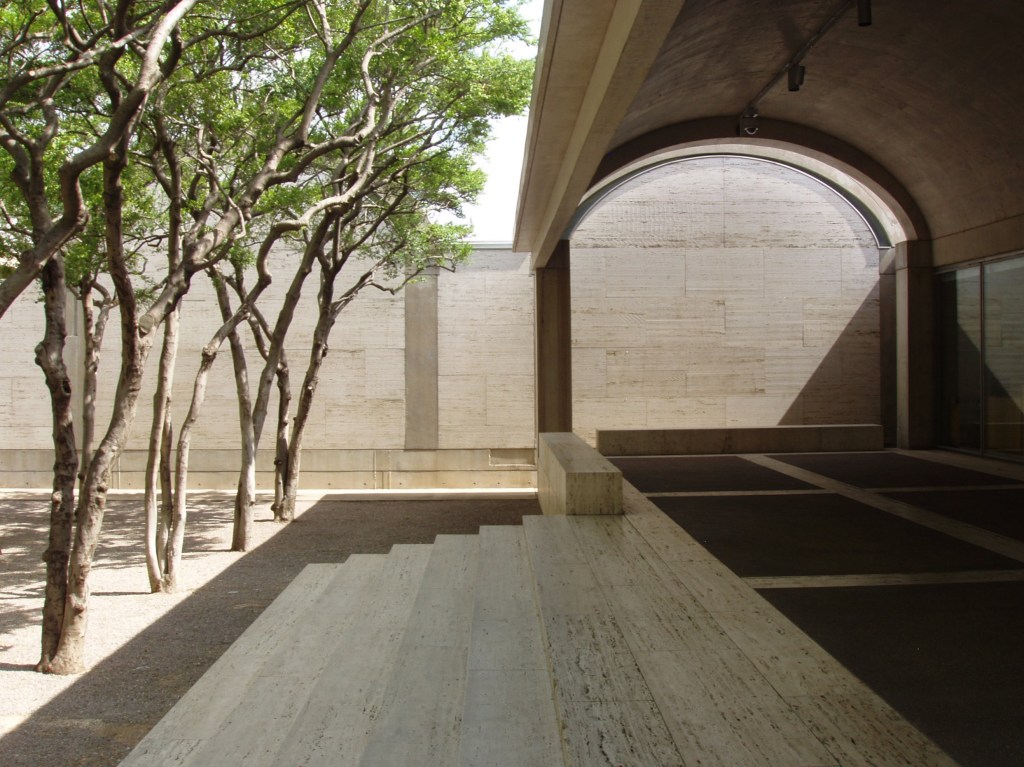
There are some buildings that are so famous that you think you know them well before you visit them. Several years ago, I found myself in Fort Worth with half a day free before a flight and grabbed the chance to visit Louis Kahn’s Kimble Art Museum. To the astonishment of my US colleagues, I decided to walk the mile and a half across town to get there, with the only other pedestrian whom I met during my journey pushing his belongings in a shopping trolley. Despite all the photographs and several studies of the building’s plan and section, nothing had prepared me for the entrance sequence.
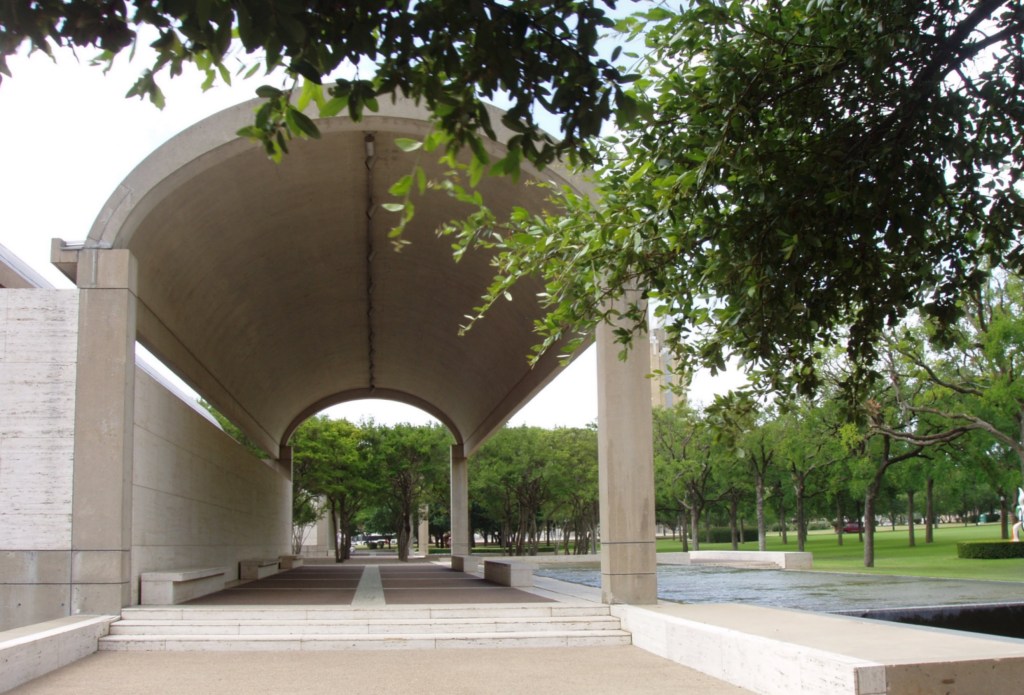
You approach the building side-on (either from the park as I did, or from the car park on its other side) with the famous vaults silhouetted against the skyline. A few steps take you up onto the paving of the colonnade which faces the rest of the park (above) with a long pool of moving water parallel to it. I’d anticipated that a stroll along here would take me to the entrance, but instead, at the end of the colonnade, a few more steps took me down into gravel, amidst a grove of trees which sat between the two entrance colonnades. From here, you then just wander through the trees on the diagonal, to a further flight of steps, which take you back up onto the now marble-paved tabula rasa and the entrance doors (top).
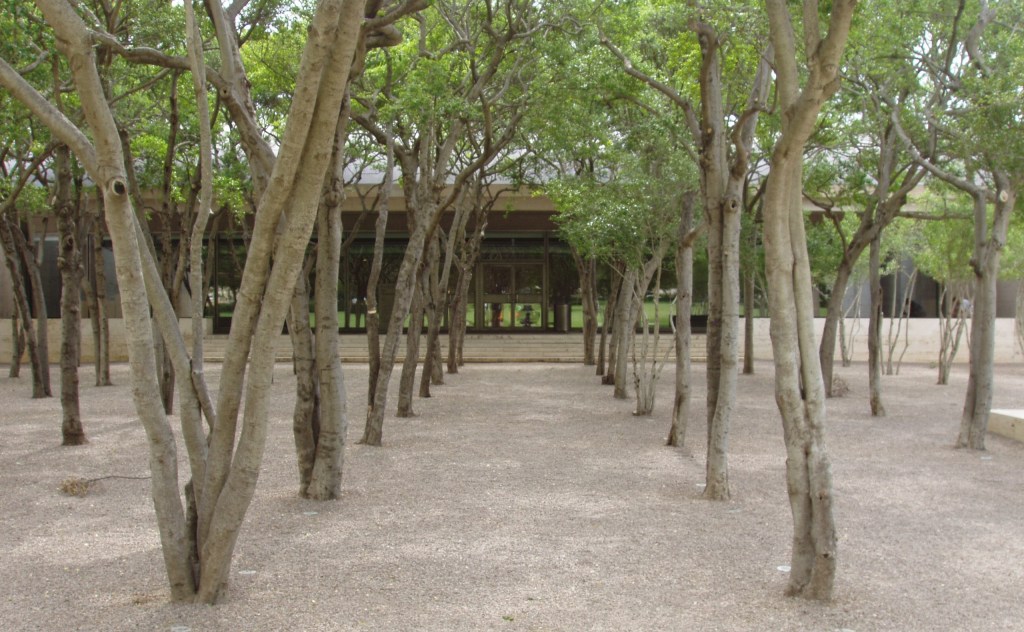
After the sophistication of the exquisite concrete vaults, beautifully-detailed paving and elegant pools, suddenly being tipped onto gravel and being expected to navigate through the trees to the entrance, comes as an astonishing shock. My reading of it was that Kahn evolved this entry sequence to heighten your senses before viewing the art collection within the building, but visiting his Salk Institute in San Diego a year or so later, I found, to my astonishment once more, another (rarely photographed) grove of trees which had to be traversed (on the diagonal) to reach the entrance (or in that case the central court and the ocean). Again, the contrast between its informality and the classical formality of the buildings intensified the experience, but I felt that there had to be more. Were we emerging from the darkness of the forest, and finding civilisation on a higher plane? Was this some ancient grove which like the ruins of Rome, had been distilled by Khan into a new form and purpose, or was it some kind of filter, through which visitors had to navigate, before reaching his monument? Perhaps, it’s all these things…..Khan worked on a plane rarely reached by other Modernists.
Sadly, another of Khan’s masterpieces, the Indian Institute of Management in Ahmedabad is now threatened with partial demolition. Please sign the petition at http://chng.it/JxmyJq5ssM to help to save it.
If you don’t want to miss out on further blogs then follow me on johngooldstewart.com

