Blog 8

New Delhi is often referred to these days in architectural circles as “Lutyens Delhi” but this does a huge disservice to Sir Herbert Baker who was responsible for the design of at least as many of the new city’s buildings as Lutyens. Lutyens and Baker were actually appointed as equal partners to both advise the Indian Government on all architectural matters relating to the new city and to design the principal buildings. In a fairer world, Baker might well have been appointed instead of Lutyens as he had already completed numerous public buildings including the South African government buildings in Pretoria (The Union Buildings) whereas Lutyens at this point in his career was very much still a country house architect; but Lutyens was based in London while Baker was in Johannesburg and his contacts proved crucial to his securing first the town planning and then his architectural role.

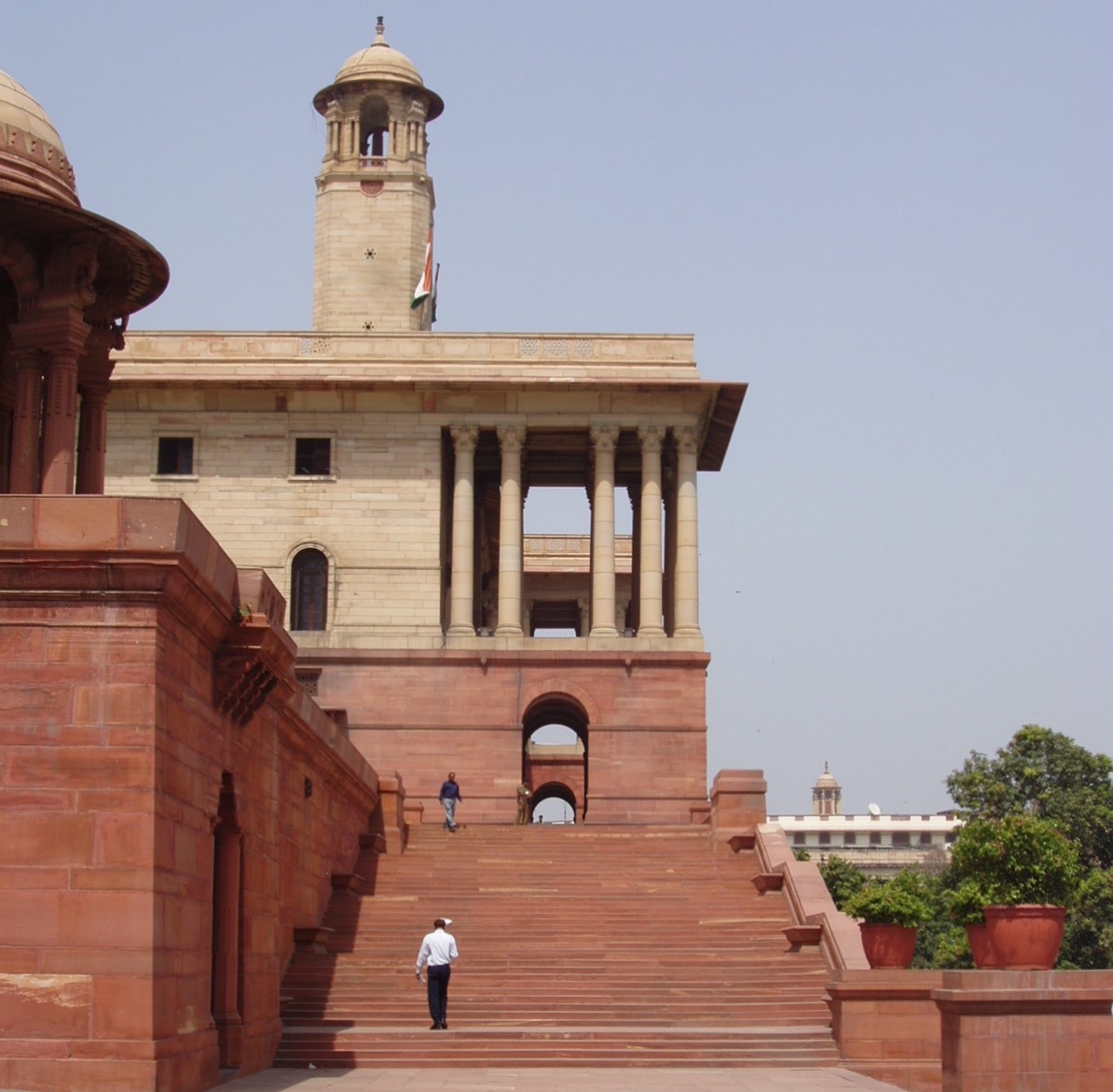
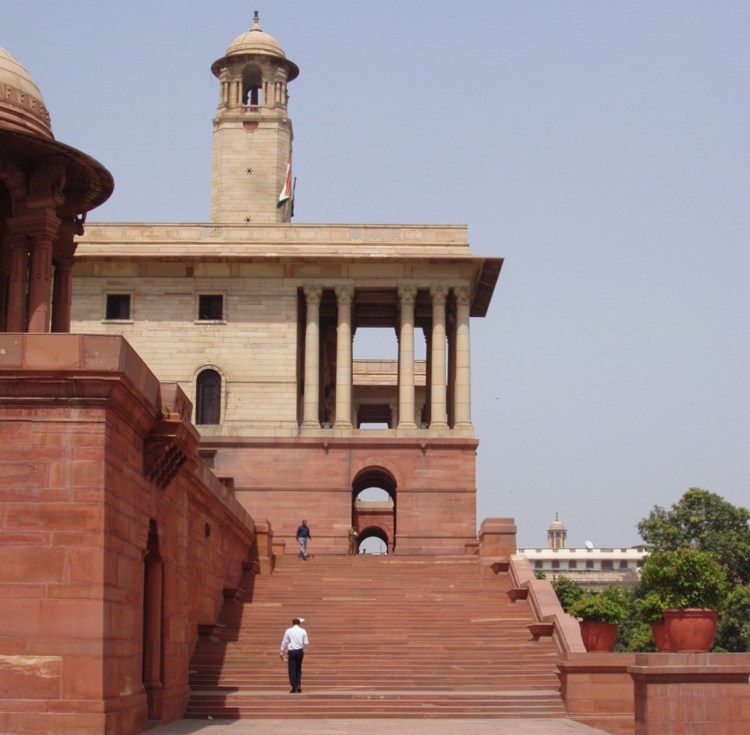
Amongst many other buildings, including the Indian Parliament, Baker designed the two Secretariat Buildings (above) to house the Indian Civil Service, which flank the processional way that leads to Lutyens’s Viceroy’s House. Each one is the size of the UK Houses of Parliament and while the interiors of Lutyens’s Viceroy’s House have been much published, Baker’s stunning interiors in the Secretariats are little known and now rarely seen by the public. The style of architecture used in New Delhi also owes more to Baker than Lutyens. When Baker arrived on the scene, Lutyens and the Viceroy were already locked in disagreement over an appropriate architectural style for the Imperial buildings with Lutyens favouring European Classicism while Hardinge the Viceroy, favoured Indo-Saracenic. It was Baker who, with a finely-judged letter to The Times, proposed the middle way that was used for all the New Delhi government buildings.

One of our most outstanding, least known and understood British architects, Baker’s life and work is covered in my latest book “Herbert Baker: Architect to the British Empire” which is due to be published by McFarland in 2021.

Blog 7

Guiseppe Terragni”s Casa del Fascio in Como is quite rightly regarded as one of the seminal buildings of the “heroic period” of Modern Architecture. Designed in 1932, when Terragni was just 28, it has become world famous for its proportional system, its transparency, the layering of its different facades, as well as the clear expression both of its structure and its function. But it is a difficult building for Modernists as well, for no matter how much you focus on form and space, there’s no escaping that this was the local headquarters of Mussolini’s Fascist party. Modernism has been seen predominantly as an expression of liberal social democratic ideologies and yet here is one of its icons celebrating a totalitarian regime.

As a result of the quality of Terragni’s architecture, many have sought to excuse his complicity with those who were in power in Italy while he was working, but he would have been appalled at this suggestion of double standards. Like many of his contemporary young Italian architects, he was an enthusiastic and committed Fascist and he regarded the Casa del Fascio commission as a great honour. He described the building as “a glasshouse” in which there was “no encumbrance, no barrier, no obstacle, between the political hierarchy and the people,” while the continuous row of doors in the centre of the main facade were designed to spring open simultaneously, not to welcome the public in, but to allow a troop of Fascist guards to form up in the central atrium and then march out of the building into the city, without breaking formation. Mussolini himself attended the opening and spoke to the crowd below from the first-floor balcony, while a giant image of him was projected on the blank panel to his side.

It remains both a fascinating piece of architecture and an equally fascinating relic of a once hugely popular and now entirely discredited Italian political movement.

Blog 6

My blog this week is in tribute to Robert Bruce, the City Engineer of Glasgow from 1941 to 1948, who, like his namesake, was a man of courage and vision. In response to the city’s chronic housing problems, he proposed the demolition and redevelopment of the entire centre of the city, with the displaced families moved to new “satellite settlements” around its edge such as Easterhouse, Castlemilk and Drumchapel. His plan included the demolition of Charles Rennie Mackintosh’s Glasgow School of Art, Willow Tea Rooms and Glasgow Herald Building, Alexander Thomson’s St Vincent Street Church, Egyptian Halls, Grosvenor Building, Grecian Chambers and Bucks Head Building, JJ Burnet’s Athenaeum, Glasgow Savings Bank Hall, Waterloo and Atlantic Chambers, Rowand Anderson’s Central Station Hotel, James Miller’s Commercial and Union Banks of Scotland, his Anchor Line Building and Central Station, James Salmon Jnr’s Hatrack and Lion Chambers as well as major works by John Burnet Snr, John Campbell, James Sellars, John Honeyman and Charles Wilson and of course including, William Young’s Glasgow City Chambers. The city’s historic grid plan was to be swept away too, to give its citizens “more elbow room” and to complete his nightmare fantasy, the entire new city centre was to be ringed with a motorway.

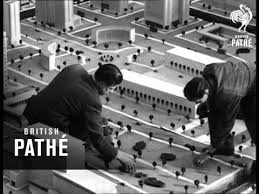
His proposals were enthusiastically backed by the City Council and launched with an exhibition at Glasgow’s Kelvin Hall where the vast model of his masterplan was displayed, (above) accompanied by a promotional film “Glasgow Today and Tomorrow” (covered by British Pathe News and available on YouTube). All the movers and shakers were on board and for a few months it seemed that Robert Bruce would be taking Glasgow fast forward into the future. Fortunately, it was fairly quickly established that his Mickey Mouse Metropolis was completely unaffordable, so Glasgow as a city was saved and when people now hear the names Robert and Bruce they think of Bannockburn, rather than what would have been perhaps the greatest act of civic vandalism ever contemplated.

Blog 5

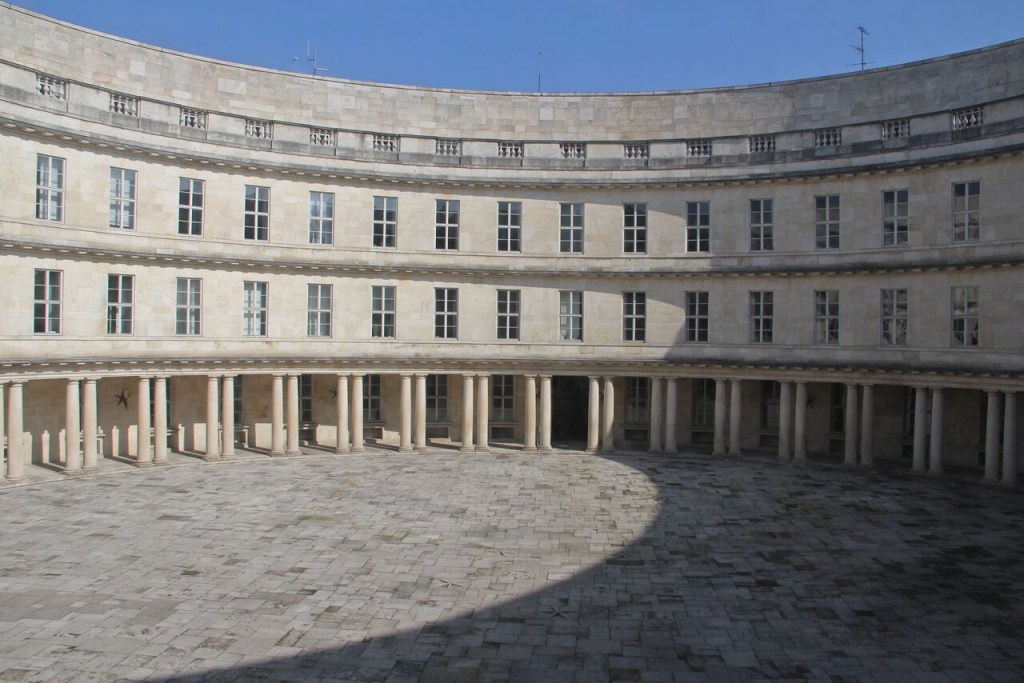
I was watching the re-run of ‘The Bridge’ recently which included intriguing glimpses of Hack Kampmann’s (1856-1920) stunning Copenhagen Police Headquarters. This proved to be his swansong and a fitting end to the career of the most prolific Danish architect of the late 19th and early 20th centuries. Like the best Nordic Classical work, Kampmann’s Politigården is designed to evoke a strong emotional response from its visitors and users. It’s grey-rendered exterior suggests the dull administration of the law, (thus lowering our expectations) and while a recessed arched portico responds to the modest square in front of it, there is no obvious entrance. From within the portico, two modest flights of stairs on either side lead visitors up to the first floor, where they are suddenly confronted by one of the most stunning exterior architectural spaces of the twentieth century (above). This represents the law in all its majesty, raised above the everyday level of life on the streets outside and bringing dignity to its pursuit. A further courtyard (reached by an unadorned alleyway) is an equally dramatic memorial to police officers killed in the line of duty. The interiors are exquisite, complete with the original fittings and beautifully maintained.

Perhaps the most interesting aspect of all about this building, however, is that it has been in continuous use since the 1920’s and (as seen on ‘The Bridge’ and ‘The Killing’) still functions effectively as the city’s police headquarters. It makes you wonder just how many other beautiful Victorian and Edwardian schools, town halls, police stations and offices could have been saved from either destruction or conversion, if their users, advisers and architects, had been a little more flexible and a little bit less dogmatic.

Blog 4

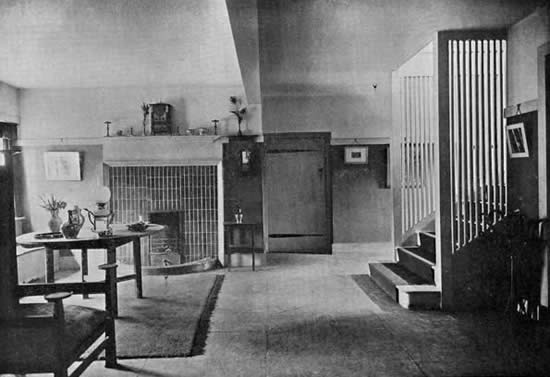
Isn’t it strange how followers of the cult of Modernism evaluate all late 19th and early 20th century architects almost entirely in terms of their contribution to the emergence of Modernism. Even more ridiculously, they project Modernist ideals onto architects who had no interest whatsoever in the principle tenets of the Modern Movement. I recently read that “Voysey (the Arts and Crafts architect Charles Frances Ainsley Voysey 1857-1941) didn’t like being referred to as a Modernist.” This might be because, despite the simplicity of his interiors and restrained palette of his exteriors, he had no interest in Modernism. Far from celebrating industrialisation and its products and considering the house to be “a machine for living”, like all the other members of the Arts and Crafts Movement, he yearned for a simpler, pre-industrial age. Far from reducing the enclosure of space to a few intersecting planes, he designed rooms of elegance and simplicity (such as in his own house The Orchard, 1899, above) and rather than considering “Ornament as Crime”, he designed wallpaper, fabrics and exquisite silverware. His fascination was not with the future but with the past and his aim was to connect with it, rather than reject it. He was not a Modernist but simply one of the finest of Britain’s many outstanding Arts and Crafts architects.

Blog 3

Tändstickspalatset

Ivar Tengbom – now there’s a name that you rarely hear in architectural circles. Once Sweden’s most successful architect (1878-1968) at a time when the competition included both Gunnar Asplund and Sigurd Lewerentz. Tengbom’s breakthrough project was the palatial Enskilda Bank (1912-15) which survives on Kungsträdgården in the centre of Stockholm, but his most famous work is the Concert Hall in Stockholm (1920-26) in which he combined an attenuated sandstone portico with a rather shocking bright blue shoebox auditorium. 

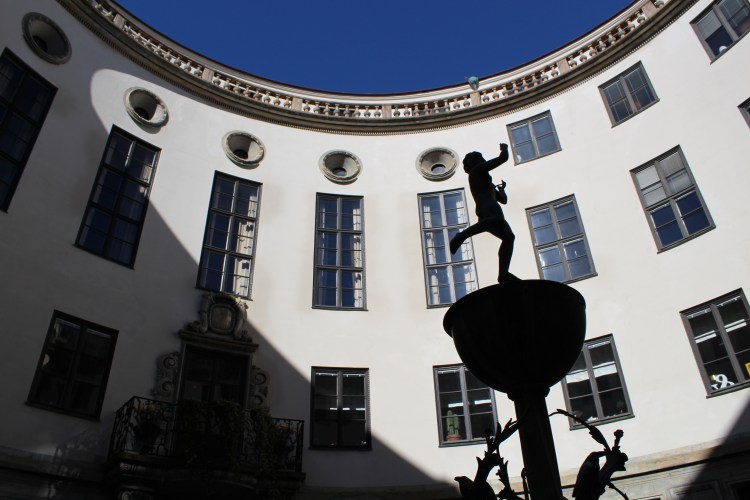
In 1925, he was commissioned to design the headquarters for the Swedish Match Company in Stockholm. This relatively modestly-named organisation was in fact one of the wealthiest companies in the world in the 1920’s, led by the charismatic Ivar Kreuger who firstly established a monopoly in Swedish match manufacturing before going on to create a property empire throughout Europe, finally becoming the lender of choice to the French and German governments. Tengbom provided him with a classic Scandinavian design in which a frankly drab exterior to the street gives way to a horseshoe courtyard of sumptuous luxury. It is treated as a forest clearing, complete with a bronze wild boar and deer who look onto the central pool which is topped by a statue of Diana the huntress, by Carl Milles. 

As in his earlier concert hall, the interiors are exquisite and provided an entirely suitable backdrop to Kreuger’s empire until its total collapse, following the Wall Street Crash. Kreuger shot himself in his Paris apartment in 1932, but fortunately, his extraordinary office survives to this day. 

Baker’s New Delhi

Weekly Blog

The photograph above is of one of Herbert Baker’s magisterial staircases at New Delhi. Most of Baker’s work in Delhi is commonly ascribed to Lutyens, but it was Baker’s concept that all the government buildings rather than just the Viceroy’s House (now Rashtrapati Bhavan – the Indian President’s residence) should be raised above the city on an Imperial Acropolis.

Lutyens and Baker were actually appointed as equal partners to both advise the Indian Government on all architectural matters relating to the new city and to design the principal buildings. In a fairer world, Baker might well have been appointed instead of Lutyens as he had already completed numerous public buildings including the South African government buildings in Pretoria (The Union Buildings) whereas Lutyens at this point in his career, was very much just a country house architect, but Lutyens was based in London while Baker was in Johannesburg and his contacts proved crucial to his securing first the town planning and then his architectural role.

Amongst other buildings, Baker designed the two Secretariat Buildings to house the Indian Civil Service which flank the processional way that leads to Lutyens’s Viceroy’s House. Each one is the size of the UK Houses of Parliament and, while the interiors of Lutyens’s Viceroy’s House have been much published, Baker’s stunning interiors in the Secretariats are little known and now rarely seen by the public. Just at glimpse at the section of the South Secretariat building below gives a hint of the spatial qualities of these buildings.

Sadly this entire area of New Delhi is now threatened with major redevelopment.